
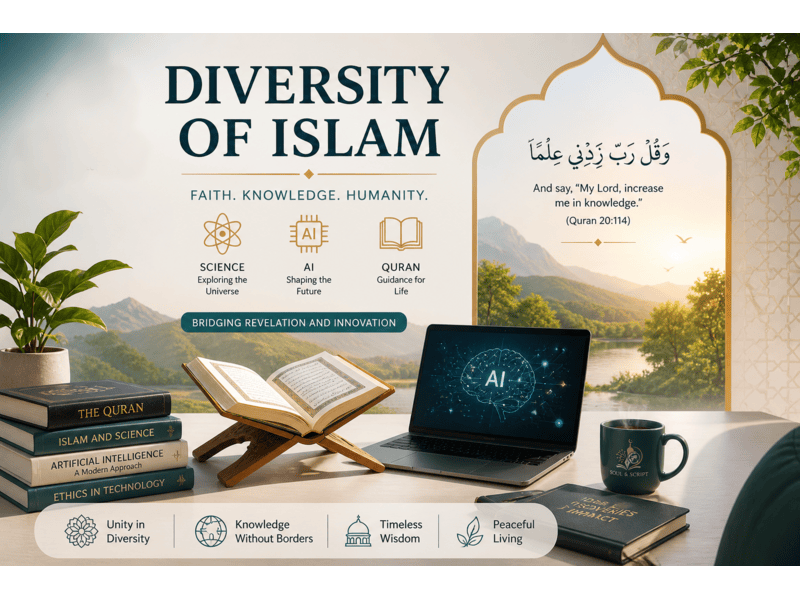
The Diversity of Islam: A Living Global Reality
Islam is often described as a single, unified faith. In reality, the diversity of Islam covers dynamic global tradition shaped by diverse cultures, languages, histories, and lived experiences. Although it is rooted in a single revelation and core belief system, Muslims across the world practice Islam in ways that reflect both deep unity and meaningful diversity—These variations reflect how a universal framework adapts to different human environments.
Core Unity of Islam
Islam maintains a strong internal unity through foundational beliefs and practices.
Diversity of Islam in pillars
- Tawhid (Oneness of God): The central belief that God is singular and incomparable, forming the basis of all Islamic thought.
- Shared worship practices: Muslims worldwide perform the same core acts—prayer, fasting, charity, and pilgrimage—creating structural unity.
- Qur’an as guidance: The Qur’an serves as the primary source of doctrine, ethics, and law.
- Prophetic tradition: The life and teachings of Prophet Muhammad provide a practical model for applying Islamic principles.
Summary
Despite cultural variation, these shared pillars ensure that Islam remains a unified religious system.
Cultural Diversity of Islam in Practice
Islam is practiced within diverse cultural environments, which shape how it appears in daily life.
Diversity of Islam in Daily life
Dress and identity: Clothing styles differ widely—Arab robes, South Asian shalwar kameez, African garments, and Western attire influenced by modesty principles.
Food traditions: Diversity of Islam feels like nothing to do in food but that’s not true. While dietary laws are consistent (halal), cuisines vary greatly based on geography and culture.
Languages: Islamic teachings are studied and expressed in many languages, not only Arabic.
Local customs: Marriage rituals, festivals, and social norms differ but remain within Islamic ethical boundaries.
Summary:
Islam provides guidelines, but cultural expression fills in the practical and social details.
Intellectual & Scholarly Diversity
Islamic thought has never been monolithic; it includes multiple interpretive traditions.
Diversity in Perspectives and Laws
- Schools of law (madhahib): Different legal schools interpret texts using distinct methodologies.
- Theological perspectives: Scholars have historically debated issues such as free will, divine attributes, and ethics.
- Interpretation (ijtihad): Reasoned interpretation allows adaptation to new contexts and challenges.
Summary:
This diversity of Islam reflects intellectual depth and flexibility rather than division.
Islam as a Comprehensive System of Life
Islam is not limited to ritual worship but provides a complete framework for living.
Matters of Life and Diversity of Islam
- Ethics: Guidance on honesty, justice, and moral behavior in personal life.
- Family system: Rules governing marriage, inheritance, and responsibilities.
- Economics: Principles such as fairness, prohibition of exploitation, and charity.
- Governance: Concepts of justice, accountability, and leadership ethics.
Summary:
Islam integrates spiritual beliefs with social, legal, and moral dimensions of life.
Limits of Representation
No single description can fully capture Islam’s global diversity to understand.
- Muslims live across vastly different cultural and economic environments.
- Practices vary depending on history and local conditions.
- Individual experiences of faith differ even within the same region.
Summary:
Any explanation is necessarily partial compared to the complexity of lived reality.
Islam and the Encouragement of Knowledge
Islam strongly emphasizes learning and intellectual development.
- Seeking knowledge is considered a religious duty.
- Wisdom is valued as something every believer should pursue.
- Learning is linked with spiritual and moral improvement.
Summary:
Knowledge is not separate from faith; it is part of religious life.
Science as a Lens for Reflection
Scientific study is often seen as a way to understand creation more deeply.
- The complexity of life suggests structured systems rather than randomness.
- Order in the universe encourages reflection on underlying causes.
- Studying nature can lead to broader philosophical questions.
Summary:
Science becomes a tool for reflection, not a replacement for belief.
Qur’anic Engagement with Natural Phenomena
The Qur’an refers to natural phenomena in a reflective, non-technical way.
- Celestial motion and orbits are described as organized systems.
- Water cycle processes are referenced in general terms.
- Human development is described in stages.
- Cosmic structure is presented as orderly and meaningful.
Summary:
These references are intended to encourage observation and contemplation.
Textual Preservation and Scientific Consistency
From a historical perspective, the Qur’an has been preserved with notable consistency.
- Early oral memorization ensured accurate transmission.
- Written records supported and verified memorization.
- Standardization reduced variation in textual form.
Summary:
This stability allows consistent engagement with its content across generations.
Science and Interpretation: Methodological Note
Comparing scripture and science requires careful boundaries.
- Only well-established scientific findings should be considered reliable.
- Scientific theories change over time and should not be treated as fixed truth.
- Interpretations must avoid forcing modern concepts onto ancient text.
Summary:
A disciplined approach is necessary to maintain intellectual credibility here comes why diversity of Islam claims as reliable source to live.
Final Synthesis: Diversity and Scientific Reflection in Islam
Islam presents a dual structure: unity in belief and diversity in expression. Within this framework, scientific reflection plays a complementary role.
- Unity is maintained through shared beliefs and practices.
- Diversity appears in culture, interpretation, and lived experience.
- Science encourages structured reflection on the natural world.
- Both knowledge and belief operate within an integrated worldview.
Unity Within Diversity
The diversity of Islam reflects its universal message—one that transcends geography, culture, and time. Rather than weakening the faith, this diversity strengthens it by allowing adaptability while preserving foundational unity.
In Essence:
- Islam is both universal and contextual
- Diversity is a feature
- Its richness lies in its ability to remain relevant across all human conditions
Final Conclusion
Islam functions as a unified religious system expressed through diverse human cultures. Its intellectual tradition supports inquiry, reflection, and learning, allowing engagement with science without losing its spiritual foundation.
Conclusion Point:
No single description can fully encompass the lived reality of Islam. Justice with each and everything.