
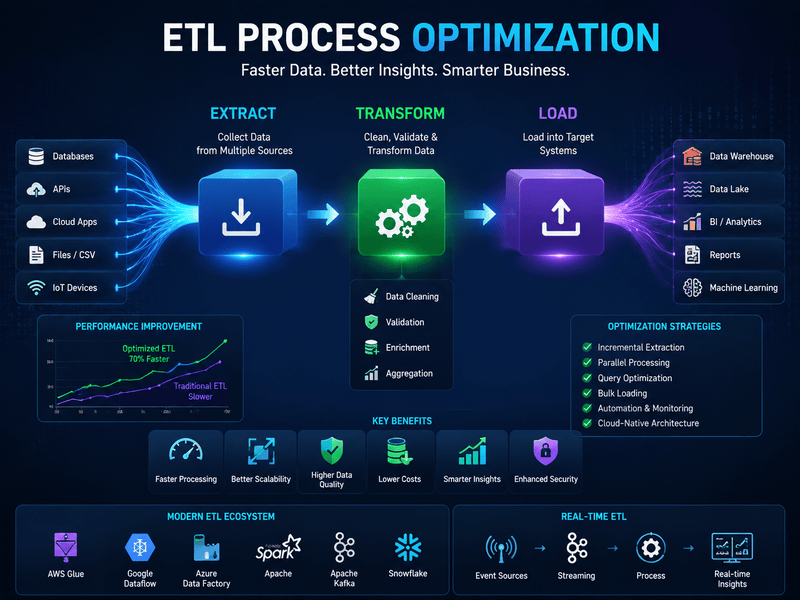
Modern businesses generate enormous amounts of data every single day. From customer interactions and sales records to website analytics and cloud applications, organizations depend heavily on data for decision-making and business growth. However, collecting data alone is not enough. Companies also need etl process optimization to move, transform, and organize that data properly.
This is where ETL process optimization becomes extremely important.
ETL stands for Extract, Transform, and Load. It is a critical data integration process used to collect information from multiple sources, convert it into a usable format, and load it into databases or data warehouses for analysis. Businesses across industries rely on ETL systems to support reporting, analytics, machine learning, business intelligence, and operational workflows.
As data volumes continue growing rapidly, organizations often face performance bottlenecks, slow processing times, data quality issues, and increasing infrastructure costs. Without proper optimization, ETL workflows can become inefficient and difficult to scale.
ETL process optimization focuses on improving the speed, reliability, scalability, and efficiency of data pipelines. Optimized ETL systems reduce delays, improve data accuracy, minimize resource consumption, and support faster business insights.
In this guide, we will explore ETL process optimization in detail, including its importance, common challenges, optimization techniques, tools, best practices, and future trends shaping modern data engineering.
What Is ETL Process Optimization?
ETL process optimization refers to improving the performance and efficiency of ETL workflows used for data integration and transformation.
An ETL pipeline typically involves three stages:
Extract
Data is collected from multiple sources such as:
- Databases
- APIs
- CRM systems
- Cloud platforms
- Spreadsheets
- Web applications
- IoT devices
Transform
The extracted data is cleaned, formatted, validated, enriched, and transformed into a structured format suitable for analysis.
Load
The processed data is loaded into a destination system such as:
- Data warehouses
- Data lakes
- Business intelligence systems
- Analytics platforms
ETL process optimization improves how these stages operate by reducing latency, improving scalability, minimizing failures, and maximizing resource efficiency.
Why ETL Process Optimization Is Important
Data-driven organizations rely on fast and reliable information processing. Poorly optimized ETL systems can create serious operational and analytical problems.
Optimizing ETL pipelines provides several important benefits.
Faster Data Processing
Efficient ETL workflows reduce the time required to process large datasets and generate insights.
Improved Scalability
Optimized systems can handle increasing data volumes without major performance degradation.
Better Data Quality
ETL optimization improves consistency, validation, and transformation accuracy.
Reduced Infrastructure Costs
Efficient pipelines consume fewer computing resources and storage capacities.
Enhanced Business Intelligence
Faster and cleaner data enables businesses to make better decisions in real time.
Common Challenges in ETL Process Optimization
Many organizations experience performance and reliability issues when managing large-scale ETL systems.
Understanding these challenges is essential before implementing optimization strategies.
Large Data Volumes
Modern organizations process terabytes or even petabytes of data regularly.
As datasets grow, ETL workflows may become slower and more resource-intensive.
Complex Data Transformations
Heavy transformation logic can create processing bottlenecks and increase execution time.
Complex joins, aggregations, validations, and calculations often impact performance.
Data Quality Problems
Inconsistent, duplicate, or incomplete data can slow ETL pipelines and reduce reporting accuracy.
Poor Resource Allocation
Improper CPU, memory, or storage allocation can negatively affect ETL performance.
Network Latency
Moving data between cloud environments, databases, and distributed systems may introduce delays.
Batch Processing Delays
Traditional batch-based ETL systems often struggle to support real-time analytics requirements.
Best Strategies for ETL Process Optimization
Organizations can significantly improve ETL performance by implementing the right optimization techniques.
Optimize Data Extraction
Efficient extraction reduces unnecessary data movement and processing overhead.
Use Incremental Data Extraction
Instead of extracting all data repeatedly, incremental extraction only processes newly added or modified records.
Benefits include:
- Faster extraction
- Reduced server load
- Lower bandwidth usage
- Improved scalability
Filter Data Early
Apply filters during extraction to avoid transferring unnecessary records.
This minimizes processing time and storage requirements.
Parallel Data Extraction
Extracting data from multiple sources simultaneously improves throughput and reduces total execution time.
Improve Data Transformation Efficiency
The transformation stage is often the most resource-intensive part of ETL workflows.
Simplify Transformation Logic
Reduce unnecessary calculations, transformations, and data manipulation steps whenever possible.
Push Transformations to Databases
Modern databases are optimized for processing large queries efficiently.
Using database-side transformations can reduce ETL engine workload.
Use In-Memory Processing
In-memory data processing improves speed compared to disk-based operations.
Optimize Joins and Queries
Poor query performance is a common ETL bottleneck.
Best practices include:
- Index optimization
- Query tuning
- Partitioning large tables
- Reducing unnecessary joins
Optimize Data Loading
The loading phase also plays a major role in ETL process optimization.
Use Bulk Loading
Bulk loading techniques reduce transaction overhead and improve insertion speed.
Partition Large Tables
Partitioning improves loading efficiency and query performance.
Disable Indexes Temporarily
Disabling indexes during large data loads can significantly improve performance.
Indexes can be rebuilt afterward.
Compress Data
Data compression reduces storage requirements and improves transfer efficiency.
Parallel Processing in ETL Process Optimization
Parallel processing is one of the most effective optimization strategies for modern ETL systems.
Instead of processing tasks sequentially, pipelines can execute multiple operations simultaneously.
Benefits of Parallel Processing
- Faster execution
- Better resource utilization
- Improved scalability
- Reduced latency
Types of Parallelism
Data Parallelism
Large datasets are divided into smaller chunks processed simultaneously.
Task Parallelism
Different ETL tasks run concurrently.
Pipeline Parallelism
Multiple ETL stages operate simultaneously across distributed systems.
ETL Process Optimization Through Automation
Automation improves reliability and reduces manual intervention in ETL workflows.
Workflow Scheduling
Automated scheduling tools help manage ETL jobs efficiently.
Benefits Include
- Reduced human error
- Better timing control
- Improved monitoring
- Consistent execution
Automated Error Handling
Modern ETL systems use automated alerts and recovery mechanisms to minimize downtime.
Metadata Management
Metadata automation improves data lineage tracking and system visibility.
Cloud-Based ETL Process Optimization
Cloud computing has transformed ETL architecture significantly.
Cloud-native ETL systems offer scalability, flexibility, and cost optimization advantages.
Benefits of Cloud ETL Systems
- Elastic scalability
- Pay-as-you-go pricing
- Distributed processing
- Faster deployment
- High availability
Popular Cloud ETL Platforms
AWS Glue
AWS Glue is a serverless ETL service designed for scalable data integration.
Google Cloud Dataflow and ETL Process Optimization
Dataflow supports real-time and batch data processing pipelines.
Azure Data Factory
Azure Data Factory helps organizations create cloud-based data workflows efficiently.
Snowflake
Snowflake supports high-performance cloud data warehousing and transformation operations.
Real-Time ETL Process Optimization
Traditional ETL systems often rely on scheduled batch processing.
However, many businesses now require real-time analytics and faster decision-making.
Benefits of Real-Time ETL
- Immediate insights
- Faster reporting
- Better customer experiences
- Improved operational efficiency
Technologies Supporting Real-Time ETL Process Optimization
Apache Kafka
Kafka enables real-time event streaming and data pipeline management.
Apache Spark
Spark supports distributed real-time and batch data processing.
Flink
Apache Flink is designed for low-latency stream processing.
ETL Process Optimization Best Practices
Following best practices helps organizations maintain reliable and scalable ETL environments.
Monitor Pipeline Performance
Continuous monitoring helps identify bottlenecks and failures quickly.
Important metrics include:
- Processing time
- CPU usage
- Memory consumption
- Error rates
- Data latency
Use Data Validation Rules
Data validation improves consistency and reduces reporting errors.
Implement Logging and Auditing
Detailed logs improve troubleshooting and compliance tracking.
Design for Scalability
ETL architectures should support future data growth and increasing workloads.
Reduce Data Movement
Moving large datasets unnecessarily increases processing costs and latency.
Maintain Proper Documentation
Well-documented pipelines improve collaboration and maintenance efficiency.
ETL Process Optimization Tools
Many tools help organizations optimize ETL workflows effectively.
Informatica
Informatica is one of the most widely used enterprise ETL platforms.
Talend
Talend provides open-source and enterprise data integration solutions.
Apache Airflow
Airflow helps automate and orchestrate ETL workflows.
SSIS
SQL Server Integration Services is commonly used for Microsoft-based ETL environments.
Matillion
Matillion focuses on cloud-native ETL and ELT workflows.
Pentaho
Pentaho supports data integration, analytics, and reporting capabilities.
Difference Between ETL Process Optimization and ELT
Modern data systems increasingly use ELT instead of traditional ETL models.
Understanding the difference is important in optimization discussions.
ETL Model
In ETL:
- Data is extracted
- Data is transformed
- Data is loaded
Transformation occurs before loading.
ELT Model
In ELT:
- Data is extracted
- Data is loaded
- Data is transformed
Transformation occurs inside the target data warehouse.
ELT is popular in cloud environments because modern warehouses can process transformations more efficiently.
AI and Machine Learning in ETL Process Optimization
Artificial intelligence is becoming increasingly important in data engineering.
AI-powered ETL systems can improve automation, anomaly detection, and workflow optimization.
AI Applications in ETL
- Automated schema mapping
- Intelligent error detection
- Predictive performance optimization
- Automated data cleansing
- Smart workload balancing
Machine learning models can also identify performance bottlenecks proactively.
Security Considerations in ETL Process Optimization
Security is a major concern when processing sensitive business data.
Organizations should implement strong security measures throughout ETL pipelines.
Important Security Practices
- Data encryption
- Access controls
- Role-based permissions
- Secure API connections
- Compliance monitoring
- Audit logging
Protecting data integrity and confidentiality is critical for modern ETL systems.
Future Trends in ETL Process Optimization
The future of ETL optimization is closely connected to cloud computing, AI, and real-time analytics.
Several major trends are shaping the industry.
Increased Adoption of ELT
Cloud-native data warehouses continue driving ELT adoption.
Serverless Data Pipelines
Serverless architectures reduce infrastructure management complexity.
AI-Driven Automation
AI-powered systems will increasingly automate optimization and monitoring tasks.
Real-Time Analytics Expansion
Businesses continue demanding faster access to insights and operational intelligence.
Data Fabric Architectures
Modern data architectures aim to improve integration across distributed environments.
Final Thoughts on ETL Process Optimization
ETL process optimization plays a critical role in modern data management and analytics systems. As organizations continue generating massive amounts of data, efficient ETL workflows become essential for scalability, reliability, and business intelligence.
Optimized ETL systems improve performance, reduce operational costs, enhance data quality, and support faster decision-making across organizations.
Whether businesses use traditional ETL pipelines, cloud-native architectures, or real-time streaming systems, optimization strategies such as parallel processing, automation, query tuning, and AI-driven monitoring can significantly improve efficiency.
As technology continues evolving, organizations that invest in scalable and optimized data integration systems will gain stronger competitive advantages in the data-driven digital economy.

Fiverr Affiliate Program: A Guide to Maximizing Affiliate Earnings
Affiliate marketing continues to grow as one of the most popular online income opportunities in the digital economy. Thousands of…


High Ticket Affiliate Marketing: How to Earn Higher Commissions
Affiliate marketing has become one of the most popular online business models in the digital economy. Thousands of creators, bloggers,…

What Is Freelancing: Complete Beginner Guide to Freelance Work
The modern work environment has changed dramatically over the last decade. Traditional office jobs are no longer the only way…

Freelancing Tips: Proven Strategies to Build Freelance Career
Freelancing has become one of the most attractive career choices in the modern digital economy. Millions of professionals worldwide are…
ETL Process Optimization: Best Strategies to Improve Data Performance and
Modern businesses generate enormous amounts of data every single day. From customer interactions and sales records to website analytics and…

Marketing Tools for Small Business: Best Platforms to Grow Faster.
Running a small business in today’s digital world is more competitive than ever. Whether you own an online store, local…
No responses yet